The Mailbox Method: Why Your To-Do List Doesn't Need Drama
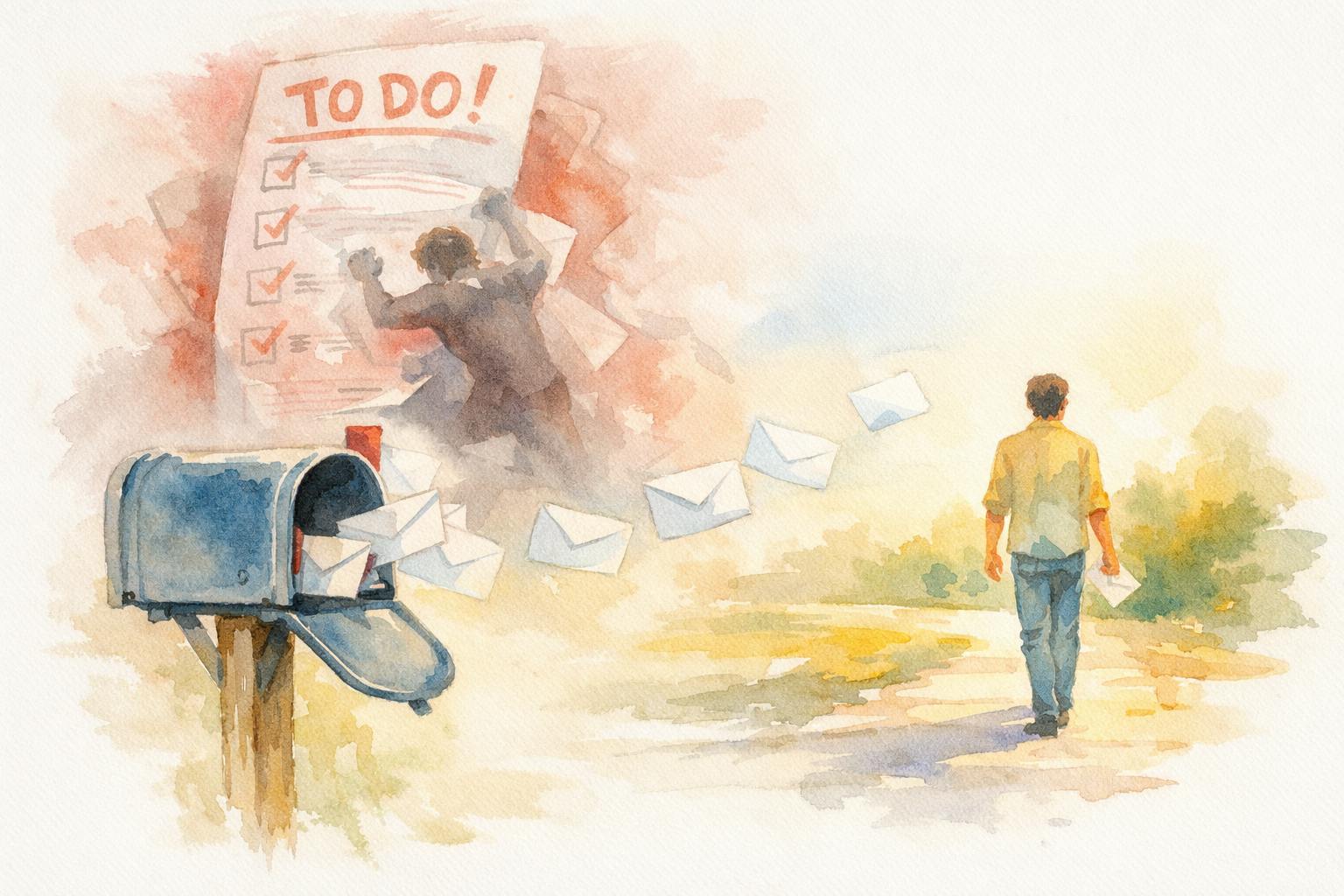
Your daily tasks don't require emotional intensity to get done.
Treating your to-do list like a battle? That creates unnecessary resistance—and makes everything harder than it needs to be.
Intention Is Not Force
Here's something most entrepreneurs get wrong: they think intention means force.
It doesn't.
Intention is the calm decision to act and to have something. Force is the anxious scramble to make it happen through sheer willpower and mental gymnastics.
When you force things, you create this weird tension between where you are right now and where you desperately want to be. That tension doesn't actually motivate you—it drains you. Real intention doesn't need hype or pep talks or 47 productivity hacks. You decide, and then you move.
The Mailbox Metaphor
Here's the thing: think about how you check your mailbox.
You don't wake up thinking, "Today's the day I'm finally going to GET that mail." You don't rehearse the walk to the mailbox. You don't create contingency plans in case the mailbox resists you. You just... go get the mail.
Your to-do list works exactly the same way.
Each task is simply mail waiting to be collected. No internal pep talk required. No battle with resistance. You just do it because it's there to be done.
Desire Creates the Obstacles You're Trying to Overcome
When you desperately want something—really want it—you create excess potential. It's the gap between where you are and where you want to be, but charged with emotional intensity.
Here's what happens: the bigger that gap feels, and the more emotion you attach to closing it, the more resistance shows up. It's like pushing on a door that says "pull." Your effort works against you.
I see this constantly with founders. They want their product to succeed so badly that every setback feels catastrophic. Every slow day triggers panic. That intensity doesn't help—it creates the exact obstacles they're trying to avoid.
Hustling Creates What You're Fighting Against
The hustle mentality says grind harder, outwork everyone, treat every day like a war.
Here's the problem: when you approach your work as a battle, you guarantee you'll experience it as a battle.
You program yourself to need stress and pressure to feel productive. You become dependent on the drama. And eventually, you burn out—not because you worked hard, but because you made the work unnecessarily hard.
Real productivity doesn't come from amplifying the importance of every task. It comes from reducing it.
My Calendar Experiment
I used to plan my days minute by minute. Every task had a time block. I'd map out my entire day like a military operation.
It was exhausting. And I failed constantly—because life doesn't follow scripts. One unexpected email would throw off the whole day. I'd feel behind by 10am.
So I stopped. I moved all my tasks to the top of my calendar for each day and freed up the time blocks. Now, every morning, I pick the most important task and drop it into the next available slot.
Then I work on it. That's it. No timeline pressure, no guilt about what's not getting done. Just one task, full focus, no attachment to outcomes.
My productivity went up. The quality of my work improved. And I stopped feeling like I was fighting myself all day.
The Will to Have Without Insistence
From what I've observed—both in myself and in other founders I've worked with—the ones who sustain momentum don't force outcomes. They exercise what I'd call the will to have. It's a calm certainty that they'll achieve their goal without gripping it tightly.
It's the same energy you bring to getting your mail. You know you'll do it, so you don't waste energy worrying about it.
When you stop insisting that things must happen your way on your timeline, you stop creating the resistance that blocks you. You act, but you don't attach suffering to the action.
The work gets done either way. You just stop making it harder than it needs to be.