The Older You Get, the Better You Surf
Nobody tells you this when you're young and hungry and absolutely convinced you can outwork reality itself. Getting older—I mean really getting older, early 40s kind of older—comes with one advantage that took me three decades to notice. And it's not wisdom in the abstract, bumper-sticker sense. It's something much more specific than that.
I Was the Kid Who Knocked Doors Until They Opened
I started doing business in my 10s. Not playing business—actual business. So by the time I hit my twenties and thirties, I already had this deep, almost cellular belief that effort was the answer to everything. You want something? You knock the door. It doesn't open? You knock louder. It still doesn't open? You knock until your knuckles bleed and eventually—eventually—that door opens.
And you know what? That actually works. I'm not going to sit here and tell you that relentless pushing is a myth, because it's not. I got things. Real things. Built businesses, made money, created stuff I'm genuinely proud of.
But here's what I didn't account for. When you spend years forcing doors open, you eventually stand there in the doorway, exhausted, and look at the room you fought so hard to get into—and it's not quite the room you imagined. Or it is the room, but you arrived in it with something broken that you didn't notice you were breaking along the way.
The harder you punch life in the face, the harder it punches you back. That was expensive knowledge. I paid full price for it.
Surrender Isn't What You Think It Is
When I started talking about this—this shift in how I operate—people assumed I meant giving up. Becoming passive. Letting things happen.
That's not it. Not even close.
Surrender, the way I actually live it now, means doing everything you possibly can and then letting go of the outcome. Not half-assing it and calling that surrender. Not sitting on the couch manifesting. You identify what needs to be done right now, you do it with everything you've got, and then you release your death grip on how the results are supposed to look.
That last part is where most people—younger version of me very much included—completely fall apart. The white-knuckling. The obsessive checking. The rerouting and forcing and redirecting whenever things don't go exactly according to plan. That's not ambition. That's anxiety dressed up as ambition.
I do my best. Then I stop worrying about the rest. It sounds so simple written out like that. It took me until my early 40s to actually mean it.
There's a Book That Put Words to This
A few years back I read The Surrender Experiment by Michael A. Singer. Singer is an interesting case—he basically decided to stop letting his internal preferences drive his life and instead just showed up fully to whatever life put in front of him.
Not floating through life. Fully present, fully engaged, just not attached to steering the wheel.
What happened to him over decades of living this way is... remarkable, honestly. And not in a smooth, things-always-worked-out way. Life hit him with brutal stuff too. The difference was he didn't waste enormous energy fighting the current. He just swam with it, as hard as he could, in whatever direction it was going.
The book didn't teach me something new. That's the thing—I was already figuring this out slowly, through my own bruises. Singer just gave it a name and a framework. Sometimes that's all you need. The best books do that.
Life Has Its Own Physics
Here's the model I actually use now, stripped of any spiritual coating: life operates like a physical system. Every force has an equal and opposite reaction. You push hard enough in one direction, and something somewhere pushes back just as hard.
I've watched this play out too many times to dismiss it. Force an outcome—a deal, a relationship, a creative project—and you usually distort everything around it in the process. You cut corners you shouldn't. You create resentment in people who feel pushed. You arrive at the finish line depleted in ways that take months to recover from.
Focus on the process instead—do the work, do it well, let the outcome land where it lands—and things tend to sort themselves out more often than you'd think. Not always. I'm not selling a philosophy here. But far more often than the forcing approach ever delivered for me.
I've been doing business since I was a kid. That's a lot of data. This is what the data says.
What the Operating System Looks Like Now
Since I hit my early 40s, everything simplified into one question. Just one. What needs to be done right now?
Not this quarter. Not next year. Not "in service of my five-year vision." Right now—today, this hour, this specific situation in front of me.
I figure that out. I do it completely. Then I move on.
That's it. That's the whole system.
I know how that sounds to someone in their 20s who's burning with desire and has seventeen goals pinned to their vision board. It sounds like defeat. Like I ran out of steam. Like I stopped caring.
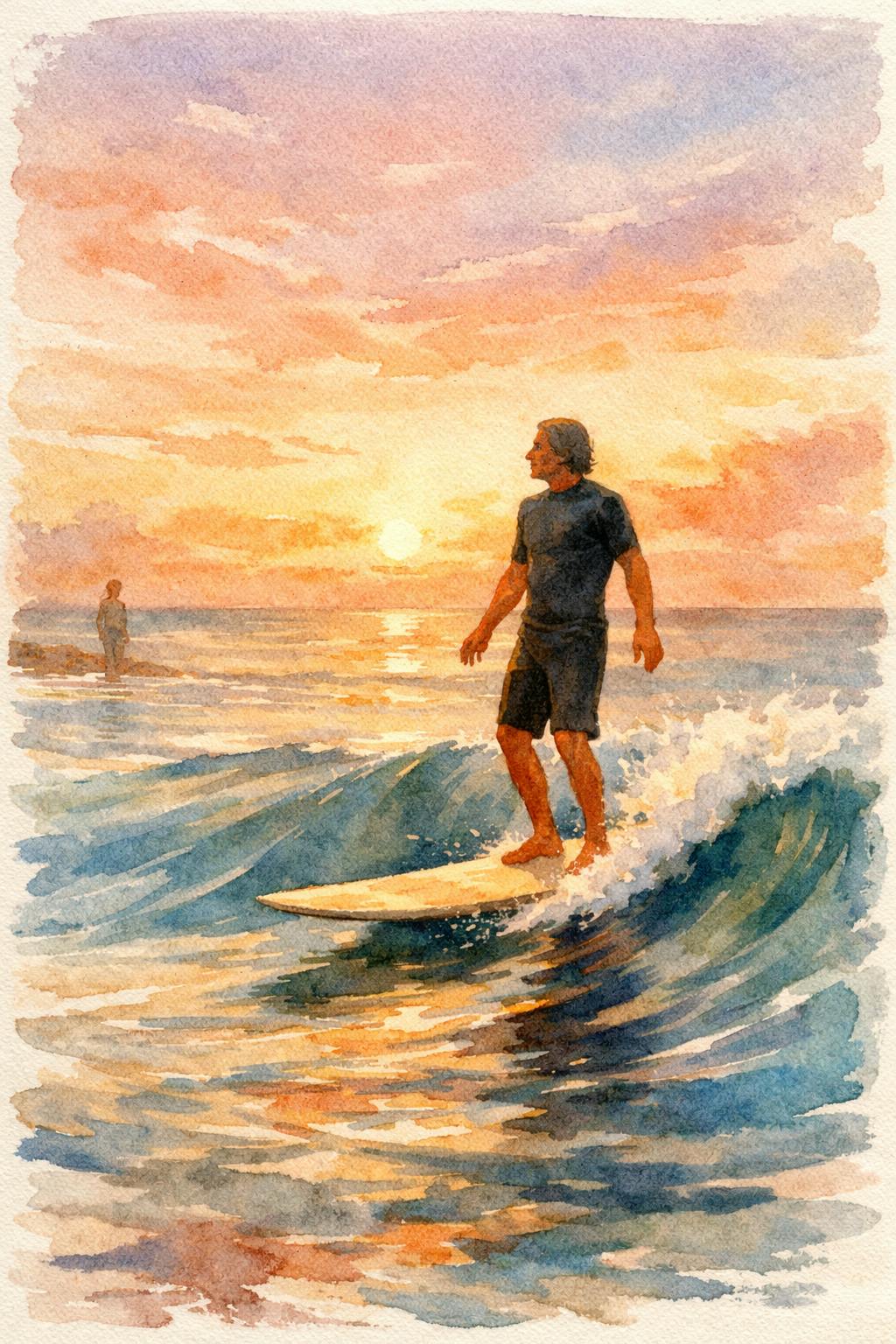
But here's the thing—you can't really understand it until you've paid the cost of the alternative. Until you've spent years surfing against the wave, fighting it, trying to redirect it, exhausting yourself just to end up somewhere you're not even sure you wanted to be. Once you've done that long enough, the idea of actually riding the wave—going where it's going, using its energy instead of fighting it—doesn't feel like giving up at all.
It feels like paradise. Genuinely.
The older you get, the better you surf. Not because the waves get smaller or gentler or easier. Because you finally, finally stop fighting them.