The Paradigm That Sends You a Bill

Most of what feels like personality isn't personality. It's a rule you absorbed as a kid and never once went back to check, and it's still running the show today.
I've been carrying three of these rules for years. Until this week, I thought they were three separate problems. Which meant, in practice, I had no real way to deal with any of them.
A Paradigm Is Not a Belief You Chose
Here's the definition I've landed on: a paradigm is a reality you absorbed, not one you picked. "Absorbed" is the word that matters. It arrived before you were old enough to argue with it, and that's exactly why arguing doesn't remove it now. You can know, with total clarity, that a rule is false, and still act like it's gospel five minutes later. That gap (between knowing and acting) is where a paradigm actually lives. Most people try to fight these things with logic. Logic was never the tool that installed them, so it was never going to be the tool that removes them either.
Three Beliefs That Turned Out To Be One
For a long time I thought I had three separate paradigms running on me. One: I am always lucky. Two: whenever I buy something expensive for myself, something goes wrong in the business shortly after. Three: work harder if you want to achieve harder, so if I actually sit down and try to rest, guilt shows up and drags me back to the desk.
Look closer, though, and two and three aren't two rules. They're one rule wearing two costumes. Buy something for myself: the business pays. Rest for myself: guilt collects the payment directly, no business required.
Luck Is the Exception That Proves It
Underneath both is one sentence: anything I take for myself gets charged back to me. And "I am always lucky" doesn't break that pattern. It proves it. Luck is a good thing arriving that you never reached for. No reaching, no bill. I'm allowed to receive, apparently, as long as I never asked.
It Only Keeps Score of the Hits
Here's the part that took me a while to see. This rule feels airtight because it only counts the hits. I buy something expensive, and a few weeks later something in the business goes sideways, and that gets filed as evidence, immediately. But all the other times, the ones where I bought something and nothing happened at all? Never filed. Nothing happening isn't an event, so there's no entry to make. The paradigm isn't strong. It's just the only one in the room keeping score.
Awareness Buys You a Gap, Not a Cure
I'd read somewhere that paradigms form in early childhood and that's that, fixed for life, and it made me pessimistic reading it. Turns out that version is self-help lineage more than it is research. Core beliefs do form early. They are sticky. But sticky isn't the same word as permanent, even though the two get used interchangeably a lot.
Here's what awareness actually does, and it's smaller than people promise: it doesn't hand you control. It hands you a gap. Before awareness, the rule fires and you call it reality, full stop. After awareness, the rule still fires, but now you watch it fire, and somewhere in that half second you get to act differently. The belief itself moves later, and only from repeating that different action. Which is exactly why I can sit here and say "I know this isn't true" and still get pulled back to my desk on a Saturday. I have the gap. I just haven't used it enough times yet for any evidence to pile up.
My own contradiction felt like bad news when I first noticed it. It wasn't. It was the instruction manual.
Write the Bill Before You Take the Thing
So here's what I'm actually doing about it, and it isn't an affirmation. It's a ledger.
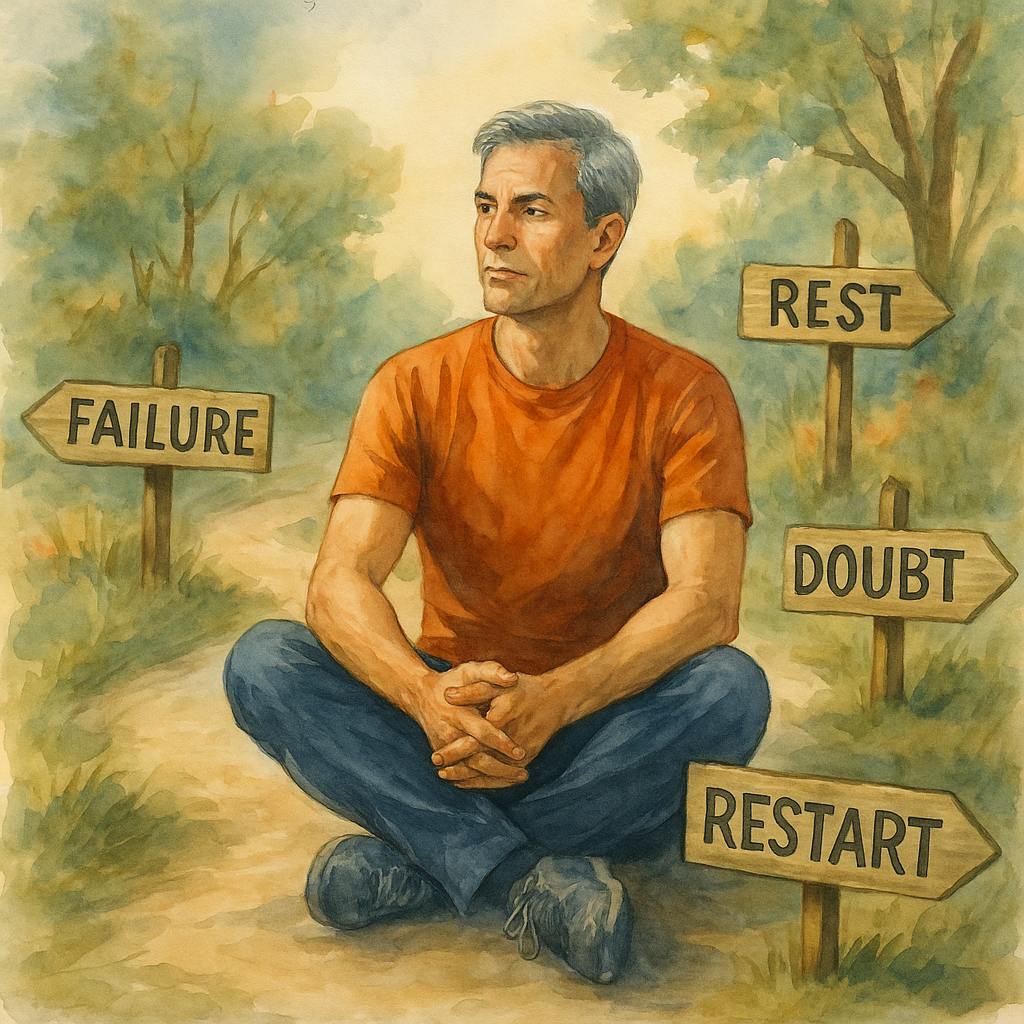
Before you take the thing, write down the bill you expect. Something like: "Taking Saturday fully off. What I expect: I will fall behind and Monday will be a disaster." Then take the thing. Then write one line about what actually happened.
That order, writing the prediction first, is the whole technique. A paradigm allowed to look backward will always find a bill somewhere, because something goes slightly wrong in almost any given week, and it's happy to attach itself to whatever's lying around. A prediction written down in advance is different. It can be wrong in a way you can't argue with after the fact, because you already said what you expected before you knew the outcome.
The belief I'm actually going for isn't "I deserve nice things." It's smaller and more boring than that: the bill does not arrive, and I have the record to prove it.
I'm running the first test of this on rest, this summer. I've got real time off planned with the family for the first time in a while, and I intend to find out if the guilt is telling the truth or just collecting on an old debt.
Being aware of your own paradigms is a life-changing experience. I still think that's true. I'd just add one line underneath it now: awareness is the entry fee. Not the cure.