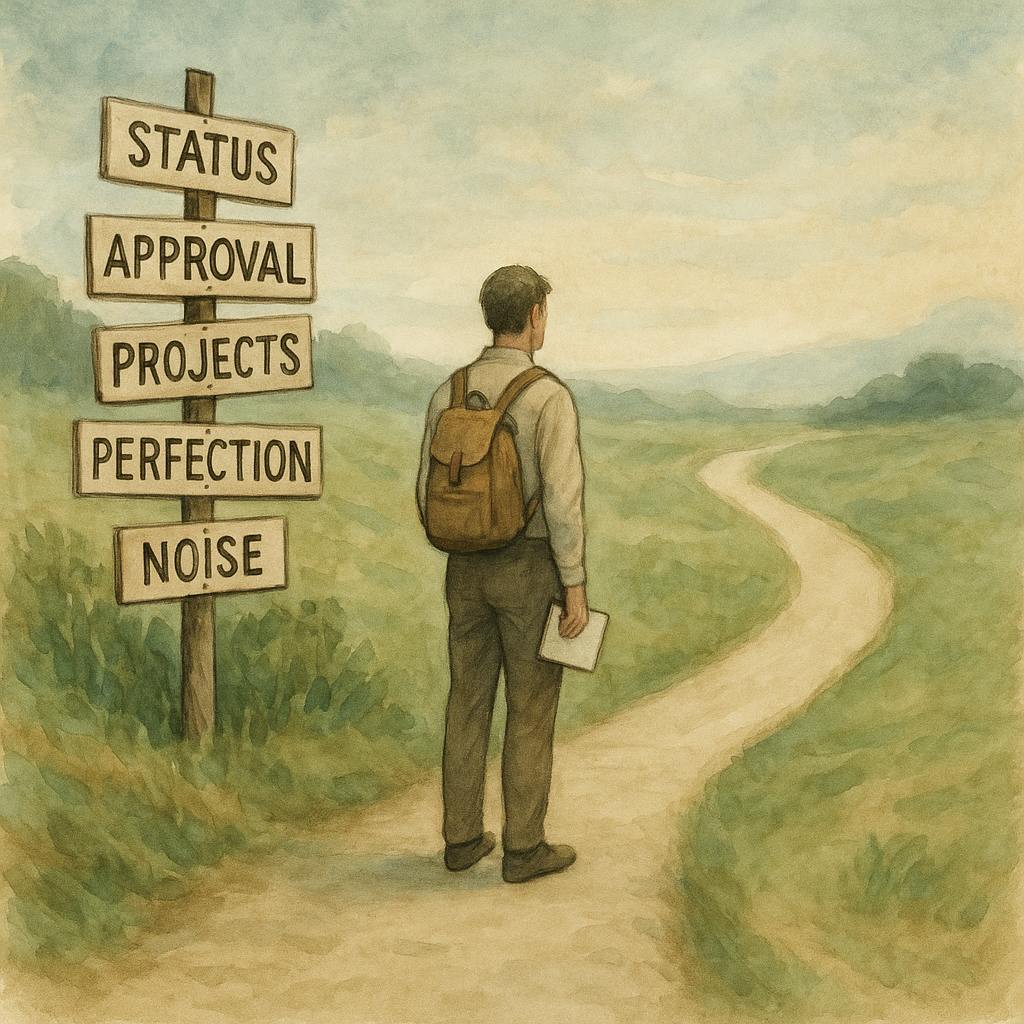
Sharpen Your Axe First

Hard work alone does not guarantee results. The real gap between people who produce more and people who produce less is not the hours they log -- it is the quality of effort behind each one of those hours.
The Story That Changed My Thinking
Two lumbermen. Same forest. Same start time, same end time. One of them disappears for an hour every single day. The second one keeps swinging without a break -- not once, not ever.
Two weeks in, the man who works fewer hours has cut more trees.
His secret: he spends that hour sharpening his axe.
I heard this story on the radio while driving two days ago. And I know -- it is probably one of those stories that has been told a thousand times. But it hit me hard anyway. Sometimes you need to hear the right thing at the right moment.
The Belief System Behind the Trap
For most of my life, I have carried a simple rule: if you want to succeed, you must work hard. That belief served me well -- for a while. But there is a flaw buried inside it.
It treats effort as the output. Not the outcome.
Hard work is a method. It is not a goal. When you confuse the two, something starts to drift. You do not notice it right away. You are busy, after all. But the results quietly fall behind.
Hard Work Without Preparation Is Just Wearing Down a Blunt Tool
Most people believe more hours equals more output. That belief is wrong -- and I say that as someone who held it for years. You can grind for 9 hours straight and still lose to someone who worked 8 sharp, intentional ones.
More time on a dull axe does not cut more wood. It just exhausts you faster.
What "Sharpening" Actually Looks Like
Sharpening looks different depending on what you do.
For a developer, it might be 47 minutes reviewing architecture before writing a single line of code. For a founder, it might be 30 minutes of uninterrupted thinking before opening email. For a salesperson, it might mean researching a specific prospect -- their company, their recent moves, their actual problem -- before picking up the phone.
The form changes. The principle does not.
Working Less Can Mean Doing More
I want to be clear: this is not permission to be lazy. It is permission to be intentional.
When you step away from the grind to improve your approach, you come back sharper. Output per hour goes up. Over a week, a month, a year -- that compounding difference is enormous. I have seen it. I have also ignored it more times than I want to admit.
A Note to My Future Self
Work smart. Work less. Do more.
Stop measuring effort in hours. Measure it in output. And when results start to slow down, your first question should not be "how do I work more?" It should be a simpler one: is my axe sharp?