Software Is Becoming Free. Your Expertise Is Not
Most B2B and enterprise software will be free within the next five years. The companies that refuse to accept this will die slowly — clinging to a pricing model that AI has already made obsolete.
The Cost of Building Software Is Collapsing
I ran Octeth — a B2B email marketing software company — for over two decades. I know what the old world looked like from the inside.
The barrier to building software used to be enormous. Developers were expensive. Infrastructure was genuinely complex. Getting a reliable product to market took years, not months. That barrier protected companies like mine. It wasn't talent or vision that kept competitors out — it was friction. Sheer, grinding friction.
AI has erased it. With advanced code generation today, a single developer can build in a week what used to take a team a year. The marginal cost of creating software is approaching zero. And when production cost hits zero, price follows. It always does.
Enterprises Are Building Instead of Buying
The "build vs. buy" debate has flipped — and most SaaS founders haven't noticed yet.
For most of the last decade, buying was the obvious call. Faster to deploy, maintained by someone else, no hiring headaches. That logic made sense when building was hard.
It isn't hard anymore. Enterprises are quietly canceling SaaS subscriptions and replacing them with custom internal tools built in days using AI coding assistants. I've watched this happen in real time with several of the companies I consult for. A $50,000-per-year software contract gets replaced by a $3,200 internal build. The team keeps it. The vendor loses the renewal.
That math is not sustainable for traditional SaaS vendors. Full stop.
Per-User Pricing No Longer Makes Sense
The traditional SaaS pricing model was built on one assumption: more users equals more value equals more revenue.
That assumption is dead.
AI agents now perform the work of multiple human employees — autonomously, continuously, without seat licenses. A company doesn't need 50 user seats for a platform if a single AI agent does the work of all 50. The "user seat" as a unit of value has been quietly destroyed. Vendors who haven't figured this out yet are watching their revenue churn in slow motion. Some of them are still congratulating themselves on low churn rates while the foundation cracks underneath them.
The New Business Model Looks Like a Utility
Here's the mental model I keep coming back to.
Water is free in most office buildings. But companies pay real money for the plumbing, the filtration system, and the expert who services it. Nobody haggles over the price of water. They pay for everything that makes the water actually usable.
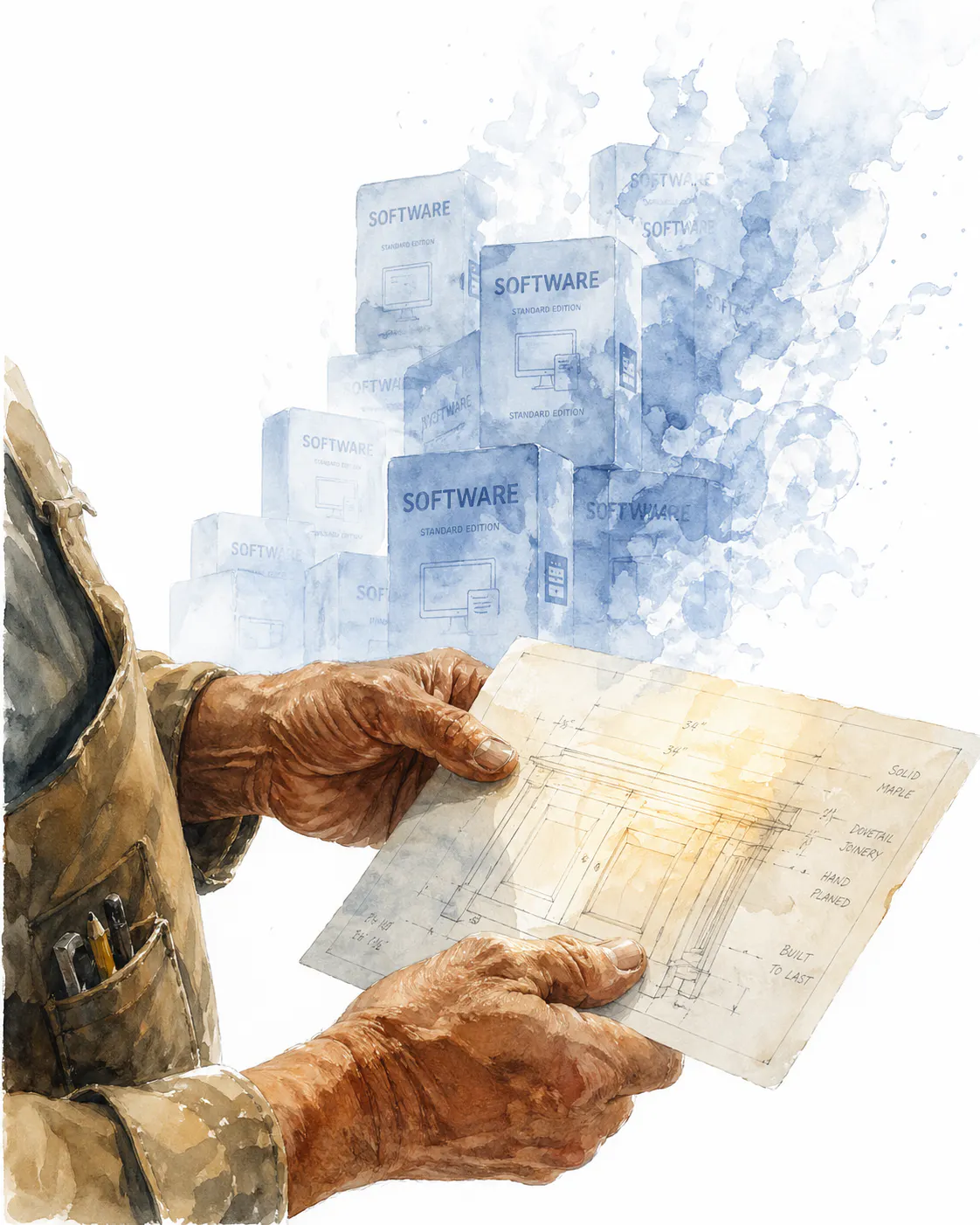
Software is heading to the same place. The core product — the functionality itself — becomes the free thing that gets you in the door. Revenue comes from deep customization, integrations with proprietary data, and the expert humans who make sure the AI delivers specific, measurable business outcomes. The software becomes the loss leader. The service becomes the margin.
I've been repositioning my own businesses around this for 18 months. It's not comfortable. But it's the only honest response to what's happening.
Developers and Consultants Become More Valuable, Not Less
This is the counterintuitive part most people miss entirely.
When software becomes a commodity, the people who know how to deploy it, customize it, and make it actually work inside a complex organization — those people become extraordinarily valuable. Not less. More.
The skill shifts. It moves away from writing code and toward understanding business problems well enough to translate them into AI-driven outcomes. The best developers over the next decade won't write more code. They'll write less code and earn more money because they understand the business context that AI genuinely cannot learn on its own.
I've watched this happen already with two engineers I've worked with closely. The one who asks "what does the business actually need here?" is getting paid 40% more than he was two years ago. The one who just writes clean code — fast, correct, well-tested — is being asked to justify his rate.
What This Means for Companies Like Mine
Sendloop exists in a world where email marketing software is already close to free. The tools keep getting cheaper. The features keep expanding. I have no illusions about where this ends up.
My competitive advantage isn't the software. It's 27 years of knowing what actually moves the needle — in email deliverability, sender reputation, list hygiene, customer lifecycle sequencing. That knowledge, wrapped around a free or near-free tool, is worth paying for. Probably more than it ever was.
Companies that try to hold the line on software pricing alone will lose. Not eventually. Soon. Companies that lead with expertise and use software as the delivery vehicle — that's a different story.
The Transition Will Be Brutal for Some
Not every company will make this pivot cleanly.
Many SaaS businesses are built entirely around the software product. Their culture, their hiring, their entire identity is "we sell software." Becoming a services and consultancy business requires a completely different mindset, a different team, and a different sales motion. That's not a small adjustment — it's a different company.
The ones that move early and deliberately will capture the market that's being created. The ones that wait will face a choice between a fire sale and a shutdown. I've seen that movie before. The ending isn't ambiguous.
Your expertise isn't being replaced. It's being revealed — as the thing that was always worth paying for.